Regulatory Signs - WEIGHT LIMIT SERIES
The Regulatory sub-categorey for WEIGHT LIMIT SIGNS - THE R12 SERIES
Q. How do I know which type of WEIGHT LIMIT SIGN should I use?
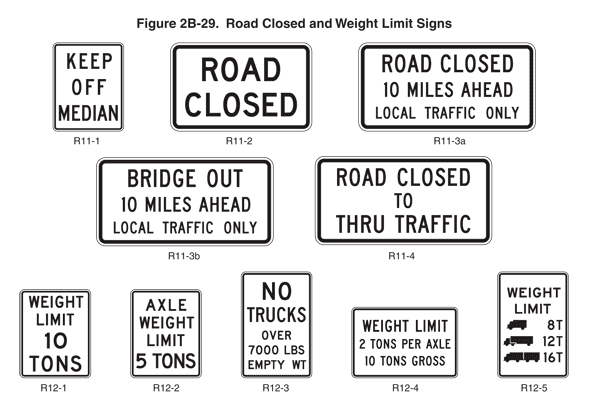
A. Weight Limit signs are essentail to road safety. Many of the bridges in the US are very old, from the Federal-Aid Highway Act of 1956. The aging bridge system in the US is at a critical stage. State bridge inspectors are regularly down-grading the weight a bridge can with-stand. This is done using the R12-5 Weight Limit Sign. Weight limits are downgraded for tonage as the bridge ages. A bridge that held up to 30 tons a few years ago, may only with-stand 25 tons now.
MUTCD weight limit signs belong to the R12 series of regulatory signs, which use black text and symbols on a white rectangular background to restrict heavy vehicles from crossing fragile bridges, culverts, or restricted roadways.
Main MUTCD Weight Limit Sign Types (R12 Series)
- R12-1 (Weight Limit - Gross Load): Displays the maximum total weight allowed on a structure or road, such as WEIGHT LIMIT 10 TONS.
- R12-2 (Axle Weight Limit): Restricts the weight allowed per individual axle, such as AXLE WEIGHT LIMIT 5 TONS or AXLE WEIGHT LIMIT XX LBS.
- R12-3 (Empty Weight / Residential Limit): Restricts trucks in residential or protected areas based on their unloaded weight, such as NO TRUCKS OVER 7000 LBS EMPTY WT.
- R12-4 (Combined Weight Limit): Combines multiple rules onto a single sign, such as WEIGHT LIMIT 2 TONS PER AXLE 10 TONS GROSS.
- R12-5 (Symbolic Weight Limit): Uses vehicle icons (box trucks, tractor-trailers, or truck-trailer combinations) paired with specific weight limits
Placement and Design Rules
- Location: Placed in advance of the restricted bridge, road section, or approach intersection so drivers have time to choose an alternate route.
- Visibility: Must be retroreflective or illuminated so they are legible day and night.
- Official Standards: Detailed specifications are maintained by the Federal Highway Administration via the FHWA MUTCD 2009 Edition guidelines.